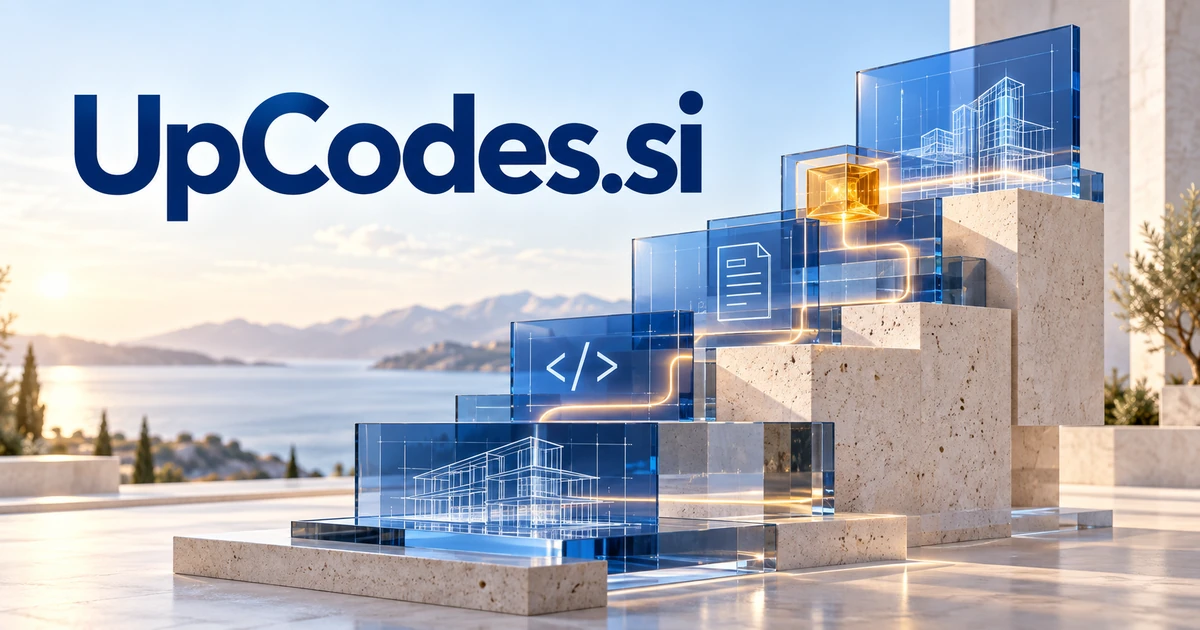
UpCodes.si pairs progress with the many meanings of code: building requirements, software instructions, standards and structured information. Its strongest opportunity is a source-linked intelligence workspace that helps professionals understand which requirements apply, what has changed and what work follows. Construction teams could use the identity for code research and project coordination; developer teams could use it for software modernization. Both directions support a Super Intelligence story grounded in connecting rules, context and reviewable action.
Meaning and naming depth
Up brings direction: moving forward, improving, raising a standard or taking something to its next level. Codes has several established meanings. Cambridge's code entry covers rules, systems for representing information and computer instructions. The plural ending gives the brand scope across multiple rule sets, versions or technical systems. UpCodes is a brand compound, rather than a claim that the joined form has one dictionary definition.
The construction reading has substantial depth. A building project can involve model codes, an adopted edition, local amendments, referenced standards and project-specific facts. The International Code Council's explanation of the International Building Code distinguishes the model code from its adoption by a governmental jurisdiction and notes that jurisdictions can amend it. A useful product would therefore connect a requirement with its location, edition and application context. This is a richer promise than simply finding a matching sentence.
The software reading uses a different kind of code but preserves the same brand logic: understand the current system, identify the desired change, and coordinate the work that gets it there. UpCodes can suggest bringing code up to date, increasing software quality or making technical information easier to use. Keeping these routes distinct gives a future owner a clear choice of market while preserving a broader improvement-oriented identity.
Business opportunities
1. A source-linked building-code research workspace
Architects and engineers could begin with a project location, use and design question. An assistant would assemble the applicable source documents, retrieve relevant passages and explain how definitions and exceptions relate to the question. It would preserve the edition and unresolved interpretation beside the answer. Construction-software teams, technical publishers and professional consultancies could sell seat licenses or project subscriptions around a research experience that turns complex reference material into inspectable working context.
2. Jurisdiction and edition change intelligence
Organizations working across locations need to know when a reference changes and which projects may be affected. UpCodes could connect adoption records, local amendments and an internal project register. A monitoring agent would identify a change, compare the relevant text and draft a project-specific review queue with source links. Architecture groups, engineering practices and portfolio owners could buy multi-office subscriptions, while data providers could offer a maintained jurisdiction-information API.
3. Drawing-to-requirement review preparation
A design team could connect selected drawing sheets, schedules and project assumptions with the requirements it wants to investigate. Specialist agents would extract the relevant dimensions or labels, locate supporting clauses and prepare questions for a professional reviewer. The output could be a marked review pack with missing information and traceable observations. Design-software developers and plan-review service companies could sell per-project workspaces or drawing-volume plans, beginning with a well-defined class of review tasks.
4. Retrofit and change-of-use planning
Existing-building projects require an understanding of the starting condition as well as the proposed work. UpCodes could organize surveys, existing drawings, intended changes and cited requirements into alternative planning scenarios. An assistant would explain which assumptions alter a route and identify the records needed to investigate it further. Building consultants, property teams and retrofit-software companies could sell assessment packages, project subscriptions or professional workspaces that keep design choices connected to their evidence.
5. Permit submission coordination
Project coordinators could use a workspace that connects submission instructions, discipline responsibilities and the current document set. UpCodes would focus on the requirements that make a package complete, connecting every requested item with its current document and responsible discipline. Agents could compare a checklist with the uploaded files, identify inconsistent details and assemble a response log for reviewer comments. Permit-service providers, construction-software vendors and multidisciplinary practices could support the business through project fees or organization licenses.
6. Product specification and technical evidence
Manufacturers and specifiers could connect product data, test reports, installation instructions and proposed applications. A research assistant would locate the evidence relevant to a stated requirement, identify differences between product variants and prepare questions about missing documentation. The commercial product could serve materials suppliers, specification-software teams and engineering consultancies through catalog subscriptions, enterprise licenses or paid technical workspaces. Its value would lie in making evidence usable across the specification workflow, with the original reports still visible.
7. Field inspection and corrective-work coordination
Inspectors and site teams could record observations, photographs and project references in a shared workspace. UpCodes would relate an observation to the relevant drawing or requirement, draft a structured issue and carry it into a corrective-work plan with an owner and review history. Inspection-software companies, contractors and facilities operators could buy user-based licenses or project plans. The brand connects the technical reference with the work needed on site, preserving the difference between an observation, an interpretation and a closed issue.
8. A legacy-software modernization workspace
A developer team could connect source files, interface contracts, tests and operational notes before changing an older system. Specialist agents would map dependencies, identify behavior that must be preserved and propose small migration steps with repeatable checks. Engineering-tool companies and modernization consultancies could sell team subscriptions or paid project environments. Bring the code forward becomes a concrete promise when the product ties each proposed change to the behavior it is intended to preserve or improve.
9. Dependency upgrades and release preparation
Maintainers could connect manifests, lock files, release notes and application tests to a proposed package upgrade. An assistant would trace affected dependency paths, explain breaking changes and prepare an ordered review plan. GitHub's dependency-graph documentation describes a concrete foundation: dependency information drawn from manifest and lock files, including relevant version, license and vulnerability details. Developer-platform businesses could sell repository-based subscriptions, private deployments or update-coordination services.
10. Policy-as-code and technical governance
Enterprise teams could connect a written policy, its executable checks and the systems expected to follow it. UpCodes would identify where the same rule is expressed differently, propose a reconciled change and prepare test cases for review. Infrastructure-software providers, governance teams and specialist consultancies could sell organization licenses or managed policy libraries. The NIST Secure Software Development Framework offers a relevant reference for integrating security practices into a development lifecycle; a future product could map its own workflow to such documented practices.
11. Error-code diagnosis across connected systems
Support engineers could supply an error identifier together with logs, product versions and recent changes. An assistant would retrieve the relevant documentation, compare the observed symptoms with plausible causes and propose a diagnostic sequence that can be reproduced. Device manufacturers, industrial-service teams and developer-tool builders could sell support workspaces or usage-based diagnostic APIs. Here, codes means structured signals, and up expresses restoring a working system through a clearer understanding of what the signal represents.
12. A learning environment for rules and software
A training provider could build interactive exercises in which learners investigate a rule, change a code example or compare two versions of a technical requirement. A teaching assistant would explain the reasoning, point to the supporting material and adapt the next exercise to the learner's demonstrated understanding. Professional education teams and developer-learning businesses could sell individual subscriptions, course licenses or employer learning plans. Separate tracks would let one name support technical progress without treating construction rules and programming syntax as interchangeable.
A Super Intelligence product story
Imagine a design team revising an existing building. The question is not only “What does this clause say?” It is “Which documents apply to this project, what changes under this proposal, and what must we investigate next?” An UpCodes workspace could assemble the source history, connect the proposal to the existing condition and prepare coordinated questions for the design disciplines. The resulting review pack would expose assumptions and alternatives rather than compressing the project into an unexplained score.
A software team could ask the same kind of contextual question about a framework migration. One specialist maps the current system; another examines the target requirements; a third proposes tests and a staged work plan. This is the shared Super Intelligence idea: reason across requirements and systems, then organize understandable progress. The implementation and buyer would differ by market, while the brand's promise stays coherent.
Why the name works
Seven letters, familiar English components and the visible division UpCodes make the name compact enough for a workspace or reference product. The upward direction adds movement to an information-heavy subject. The plural ending supports a collection of sources, a cross-project platform or a family of technical tools.
“Understand the rules. Move the work forward.” suits the building-research direction. “Bring your code forward.” suits modernization. “From requirements to a reviewable next step.” connects both with intelligent coordination. A future owner can choose one clear launch market and still retain naming room for research, monitoring, review and learning products as the business develops.
Related names, different directions
- CloudGateway.si — Focus on routing, integration and access across connected infrastructure.
- Prefactor.si — Explore technical modeling, scientific assumptions and reproducible analysis.
- VDR.si — Organize evidence rooms and controlled review across complex projects.
- GuideX.si — Build a guided learning or adoption experience around an individual process.
Acquire UpCodes.si
Buy or make an offer on Dynadot, or email hedge.pike02@icloud.com to discuss a direct purchase, a possible discount, or a portfolio bundle. These product directions are proposals for a future owner to develop.
Purchase options and Escrow.com · Browse all domains
Research references
- Cambridge Dictionary: code — Established rules, information-symbol and computing meanings behind the naming analysis.
- International Code Council: the International Building Code — The distinction between a model code, jurisdictional adoption and amendments that informs the construction-workspace concepts.
- GitHub Docs: dependency graph — Manifest, lock-file and dependency information behind the software-update workflow analysis.
- NIST: Secure Software Development Framework, SP 800-218 — A documented framework for integrating security practices into software development.